Friday, 20 September 2013

L is for Larus

LARUS (Lariid gulls)


Ok, this is cheating. This entry could have been focussed on the Lesser Black Backed Gull Larus fuscus, but it is difficult to talk about this species without comparison to others in the genus*.  
Any trip to the British coast will have a background of ‘gull-ness’, both the soundtrack of their territorial ‘trumpet calls’ and the image of pale ‘V’-shaped birds flying across the blue sea (No ship painting is worth its salt without gulls in), and of course the presence waiting for you to drop a chip. Love them or loathe them, they are the classic sea bird (Indeed the name Larus means ‘a sea bird’) and they add a certain romance to a beach holiday.
But look closer and you’ll notice different species. The larger gulls are distinguishable by the shade of their wings. The classic blue-grey ‘Sea gull’ the Herring Gull L. argentatus (meaning ‘decorated with silver’), the darker grey Lesser Black-backed Gull L. fuscus (meany ‘dusky’) and the pitch black, Greater Black-backed Gull L. marinus, the largest gull in the world.  They are fairly similar, with a dagger-like yellow bill, red spot on the lower jaw (which acts as a feeding signal to their young), black-and-white tipped wings and a furrowed brow. The juveniles are a spotty brown. You may see another Lariid, the Common gull L. canus which is smaller with a slimmer, all yellow bill and rounded head. They are named from the middle English meaning plain, not abundant2. A recent arrival, The Mediterranean gull L. melanocephalus , has a black head in summer, reduced to a spot in winter and a thick red beak (not to be confused with the black-headed gull Choriocephalus ridibundus).
Of course, you don’t have to go to the coast any more to see gulls in Britain. They’re now common in our cities, parks and rubbish dumps.  Herring gulls only moved into cities during the 1940’s3. Since then both Herring and Lesser Black Backs have increasingly exploited the artificial cliffs of flat-roof buildings for nesting (Much to the dismay of many human occupants), whilst commons forage on playing fields. The Great black-back is more coastal and hasn’t taken to landlubbing ways.
Gulls are able to adapt to new lifestyles with their generalist diet. They are omnivores, gulping down a variety of land and water invertebrates, small vertebrates, some plantstuffs, carrion and human scraps . On the coast they are mainly fish eaters, hence the herring gull was named as feeding flocks signalled the location of herring Clupea spp. shoals to fisherman, whilst the lesser black back was known as the ‘Coddy moddy’ for following young cod Gadus morhua2.  Gulls can swallow large fish whole to gorge themselves (I once saw Japanese tourists feed a whole medium battered cod to a herring gull in one!).
The Great black back is a ferocious predator of larger animals including rabbits and seabirds. The common gull takes smaller fish and invertebrates, and unusually eats grain, hence the Devonshire name ‘Barley bird’2.
Gulls have developed new behaviours to get their food, such as pirating from other seabirds, pattering the ground with their feet to bring up earthworms, dropping shellfish onto rocks to crack them and puncturing bin bags. They find a bonanza of easy pickings at rubbish dumps, but their adventurous tastes get them into trouble with inedible objects. One gull was found to have swallowed a mobile phone4!  The increasing amounts of plastic waste in our oceans is a huge problem for many seabirds.
With gulls increasingly moving into our living space, they seem to be doing well. The Lesser Black Back, traditionally a summer migrant wintering in Southern Europe, is even increasingly staying over5. However, the bigger picture is not good. The Herring gull is on the red list of threatened British birds, and the Black-backs and Common are classed as Amber3,6. Rather than expanding, gulls are being pushed to move inland as overfishing depletes their natural food sources7. Whilst landfills once attracted them in needy times, inland gulls are now doing better than coastal dwellers, even though we try to deter them as a nuisance7. The fact is, if we want our seaside soundtrack to last, Britain’s gulls need all the support they can get.


*All of Britain’s gulls except the Kittiwake Rissa tridactyla used to be classed in the Larus genus, but a genetic study revealed this to be inaccurate1. Thus the Black-headed Gull Choriocephalus ridibundus and the Little Gull Hydrocoloeus minutes are now classed separately.

The term 'Seagull' is technically wrong. It is not opposed to anything (i.e. there are no land gulls, river gulls etc) and most gulls do not rely on the sea. It’s often said only to truly apply to the kittiwake, a strictly oceanic species, but the name originally applied to the Common gull2.


References

11-      J.-M. Ponsa, A. Hassanina, and P.-A. Crochet. (2005) Phylogenetic relationships within the Laridae (Charadriiformes: Aves) inferred from mitochondrial markers. Available from: http://www.researchgate.net/publication/7692222_Phylogenetic_relationships_within_the_Laridae_%28Charadriiformes_Aves%29_inferred_from_mitochondrial_markers

22-      Fransesca Greenoak. (1979) All the Birds of the Air. A. Brown and Sons.

33-      RSPB. (2013) Advice: Urban Gulls. Available from: http://www.rspb.org.uk/advice/gardening/unwantedvisitors/gulls/urbangulls.aspx

44-     C.J.Camphuysen, S.Boekhout, A.Gronert, V.Hunt , T van Nus. and J. Ouwehand, (2008). Bizarre prey items: odd food choices in herring gulls and lesser black-backed gulls at Texel.  Sula 21, 49-61. Cited by: Darren Naish. (2009) Mobile phones, medals, a doll’s legs, an entire army… is there anything a gull won’t swallow? Available from: http://scienceblogs.com/tetrapodzoology/2009/12/19/gull-swallows-phone/

55-      R.A. Robinson./ (2005) BTO BirdFacts: profiles of birds occurring in Britain & Ireland: Gulls: Lesser Black-backed Gull Larus fuscus   [Linnaeus, 1758]. Available from: http://blx1.bto.org/birdfacts/results/bob5910.htm

66-      R.A. Robinson. (2005) BTO BirdFacts: profiles of birds occurring in Britain & Ireland. (BTO Research Report 407). BTO, Thetford. Available from: http://www.bto.org/birdfacts

77-BBC. (2012) Who What Why: Why are there so many seagulls in cities? BBC News Magazine. Available from: http://www.bbc.co.uk/news/magazine-19490866


Thursday, 12 September 2013

K is for Kingfisher

KINGFISHER (ALCEDO ATTHIS)


The kingfisher is undoubtedly one of Britain’s most beautiful birds. Though usually seen as a metallic blue flash as it whizzes away, this is enough to bring joy to a riverside walk.
The kingfisher’s glimmering plumage is unrivalled amongst British birds.  The contrasting glittering, deep blue-green upperside, orange chest and smart white dashes make this living jewel.  The silvery-turqouise back provides the distinctive gleam from behind. The secret to the kingfisher’s glowing colours is the way their  feather structure reflects light, known as ‘structural colour’, creating their metallic sheen. Without this effect, they would simply be dark brown1!
Males and females can be told apart by their beak colour. Females have an orange lower jaw, whilst the male’s is completely black.

The kingfisher is fairly common on rivers, streams and lakes, though is rarely seen by most people. Its habit of perching in waterside trees obscures it from the banks and it is more easily seen from the water .  During my time in Worcester with the rowing club, I used to see several kingfishers with each practice, yet I only saw one from the banks.

Appearances aside, the kingfisher certainly lives up to its name with its predatory skill.  They hunt from a perch on a branch or stem(sometimes even a fisherman’s rod!), or sometimes by hovering, over the water.  Seeing into water presents challenges, but the kingfisher overcomes these with eyes which polarize light to neutralise the reflection of the surface, and the mental ability to calculate refraction effect (the bending of light through the water)1.  Once focussed, the bird dives in like a harpoon up to 25cm deep, locates and grabs its quarry by touch, bobs to the surface and pushes off with its wings back to the perch all in a split second (See this stunning  slow-motion BBC footage of a kingfisher strike).  The kingfisher then bashes its prey against the perch to stun it into submission before swallowing it whole. Their main prey is, of course, small fish though shellfish such as small crustaceans, water beetles and insect larvae are also on the menu 2.

Unsurprisingly for such a beautiful bird, the kingfisher has a history of human admiration.
The Ancient Greek Moon Goddess, Alcyone was believed to protect sailors from storms and to be responsible for the yearly resurrection of Zeus. When Zeus defied her power and killed her husband Ceyx at sea with a lightning bolt, Alcyone plunged into the water and the couple were turned into kingfishers. It is from their names that the scientific genus name ‘Alcedo’ derives3.

Alcyone could still control the sea in her feathered form. This gave us the poetic expression ‘Halcyon days’, applying to the real phenomenon of the calming of the Mediterranean sea during midwinter, when it was believed that the kingfisher bred on a floating nest made of fish bones3.

The kingfisher’s real nest is less romantic, but still an incredible feat. Like their relatives, the woodpeckers, kingfishers dig out a nest hole.  They choose a spot of soft exposed river bank, and then fly at it and literally ram it with their beak! Once they have created a hollow, the pair excavates a tunnel about 60–90 cm (24–36 in) long ending in a nest chamber, inclined upwards to protect the nest from rising water levels4.
 For such a beautiful bird, the nest is rather sordid, being lined with fish bones and pellets of other indigestible, hard parts of prey engorged by the adults and young 4(So at least the Greeks were partly right!). The offspring poo out into the chamber, creating a harsh smell which may deter predators.

Kingfishers are very fecund, producing 2-3 broods a year4. To support these families they must maintain a fishing territory, and fights are aggressive to the point of drowning one another!

In Britain, kingfishers were hunted by the Victorians to for ornamental stuffed birds and feather hat decorations, and later water pollution from industrial and agricultural waste caused further declines.  Fortunately, improved water quality means kingfishers are now recovering. Their greatest natural threat is freezing winters, when many migrate to saltier estuaries and coasts.

So next time you walk along a British river, look for this living jewel, perhaps even watch it fishing, and be grateful that this Goddess on the river is rising again.


References


1-BBC Nature (No date). Common Kingfisher. Available from: http://www.bbc.co.uk/nature/life/Common_Kingfisher

 2-Hilary Fry, Kathie Fry and  Alan Harris. (1999) Kingfishers, Bee-eaters and Rollers. London: Christopher Helm. Cited by Wikipedia (2013). Common Kingfisher. Available from: http://en.wikipedia.org/wiki/Common_Kingfisher

3- Fransesca Greenoak. (1979) All the Birds of the Air. A. Brown and Sons.


4-Jeannine Miesle and Avianweb. (No date) Common Kingfisher. Available from: http://www.avianweb.com/commonkingfishers.html

Friday, 6 September 2013

J is for Jackdaw


Jackdaw (Corvus monedula)


It wouldn’t be right to obsess about birds without mentioning a corvid (member of the crow family). Renowned in science for their incredible intelligence and behaviour and in fiction for the folklore they are steeped in.
Of the large, black birds in the genus Corvus, the jackdaw is one of the most recognisable*. It is the smallest of the lot, with a grey bobble head, black cap, pearly white eye and of course it’s distinctive yapping call. They can be found pretty much everywhere except the barren highlands, both as townies and farmland birds, where they are one of the few species benefitting from large intensive fields. They sometimes visit gardens, especially during the breeding season and winter when there is pressure to find food1.

The Jackdaw’s name attracts a lot of interest since it includes a human one. It is usually explained as imitating their call, but the name is also used to refer to small stature such as the jack snipe (Lymnocryptes minimus).  The ‘daw’ part has a linguistic meaning, referring to ‘someone in low esteem’ possibly due to being common,  and given to thieving precious objects 2 (though ‘stealing’ is only practiced by captive corvids).

Like other corvids, jackdaws will eat pretty much anything. Though their stubby beak prevents them probing the soil like other Corvus, it is a powerful tool . I have seen them smashing open conker (Aesculus hippocastanum) shells. They do eat the eggs and young of other birds occasionally, and are apparently useful for controlling feral pigeons in this way3.On garden feeders they can be surprisingly acrobatic.


An acrobatic jackdaw on our fat ball feeder last winter

Jackdaw life revolves around the social scene. They live in flocks, foraging, flying, roosting and nesting together in groups which are often entertaining to watch. Esther Woolfston, admirer of corvids describes how they “dive with their black and sinuous flight, swoop, loop and spiral” through castle ruins4 . Within these groups there is a complex social hierarchy, and these interactions were studied very early on, in the 1930’s by Konrad Lorenz. He found that whilst bachelors are dominant over spinsters, females gain equal status as their mates once they pair up.  Individuals use this strict hierarchy, coupled with a varied body language to avoid physical fighting and dominant males often act as peacekeepers5.  If a fight does break out, the whole colony gets excited and surrounds them like children at a playground tussle6.

The advantage of group living for jackdaws is beyond simple safety in numbers. Group members actively look out for each other. If one is grabbed by a predator, the rest will bear down on the enemy, cawing angrily6. Even the passing resemblance of a fluttering black plastic bag to a struggling jackdaw can provoke them7. One of their main predators are female Sparrowhawks (Accipiter nisus), which can just about restrain one jackdaw let alone an angry flock.


 Like other corvids, jackdaws mate for life and pairs always stick together, even within the larger flock. They share nesting duties equally, and feed and preen one another. Remarkably, unlike many other ‘monogamous’ birds, Jackdaws don’t cheat on their partners, even though they have plenty of flock mates to choose from8 (Male rooks Corvus frugilegus, by contrast, regularly take advantage of neighbouring nesting females)9. Young jackdaws even generously offer food to their peers, which helps them make friends10.
Jackdaws may even be social towards other species. They often roost together with rooks, and the resulting evening flocks are a spectacle of sight and sound. Underlying these are strict rules governing the position of the species and individuals11. Fascinatingly, I met a birdwatcher  who claimed he had seen inter-species play of ‘catch the stick’ between rooks and jackdaws.

The only time Jackdaws show real hostility is when nesting. They nest in holes, a naturally scarce resource, so there is intense competition between pairs. This year’s ‘Springwatch’ focused on a Jackdaw nest that another pair were determinedly trying to oust by harassing the chicks and stealing nesting material. They commonly nest in boxes meant for owls or kestrels (Falco tinnunculus , and will doggedly defend their spot against them.  Most famously, they will use chimney pots, dropping down sticks until they form a platform, one pile measured 2.4m across and 1m high1. See one here.

Astounding footage of a Jackdaw tenaciuosly defending a next box against a Kestrel that wants it for itself.


With a complex social life and pugnacious attitude, the Jackdaw is definitely deserving of higher esteem than its name suggests. It has been a fascinating bird to research.


*The genus also includes the raven C.corax, Carrion crow C.corone, Hooded crow C.cornix and the Rook C.frugilegus in the UK.

This is not implausible, there are lots of observations of corvids playing.


References


1-BTO (2012). The Crow next ‘daw’: Jackdaw. BirdTable. Available from: http://www.bto.org/sites/default/files/shared_documents/gbw/associated_files/bird-table-70-jackdaw-article.pdf

2- Fransesca Greenoak. (1979) All the Birds of the Air. A. Brown and Sons.

3- Percy Trett. (No date) Jackdaw. Birds of Britain. Available from:  http://www.birdsofbritain.co.uk/bird-guide/jackdaw.asp


4- Esther Woolfston. (2008) Corvus: A Life with Birds. Granta Publications.

5- Konrad Lorenz . (1931) Beiträge zur ethologie sozialer Corvidae. Journal of Ornithology  80, 50-98. Cited by: A. Röell. (1978) Social Behaviour of the Jackdaw, Corvus monedula, in Relation to Its Niche. Behaviour,  64 (1/2), 1-124. Available from: http://www.jstor.org/stable/4533862

6-A. Röell. (1978) Social Behaviour of the Jackdaw, Corvus monedula, in Relation to Its Niche. Behaviour,  64 (1/2), 1-124. Available from: http://www.jstor.org/stable/4533862
      - (A thorough Paper on Jackdaws and their social behaviour)

7- Konrad Lorenz. (1952). King Solomon’s Ring: New Light on Animal Ways. (Translated from the German by Marjorie Kerr Wilson). Clay and Company, Suffolk.

8- Auguste M. P. von Bayern, Selvino R. de Kort, Nicola S. Clayton and Nathan J. Emery. (2007) 733The role of food- and object-sharing in the development of social bonds in juvenile jackdaws (Corvus monedula). Behaviour, 144 (6), 711- 733. Available from: http://www.jstor.org/stable/4536473

9- Dominic Couzens. (2012) Garden Birds Confidential. Bounty Books.

10- I. G. Henderson, P. J. B. Hart, and T. Burke. (2000). Strict monogamy in a semi-colonial passerine: the Jackdaw Corvus monedula. Journal of Avian Biology, 31 (2), 177–182.
Mentioned by:  
Dominic Couzens. (2012) Garden Birds Confidential. Bounty Books.


11- University of Exeter. (2013). How birds of different feathers flock together. Available from: http://www.exeter.ac.uk/news/research/title_271250_en.html 

Tuesday, 3 September 2013

The Awol EcoGeek


From the viewing figures, it seems that EcoGeek had a small but regular readership, for which I thank you if you are still around, and apologise for my absence. This blog was always a sideline thing to keep me occupied, but recently I’v had several things to do. Before recommencing the Avian Alphabet (J’s entry is written and illustrated), here’s an EcoGeek special of what I’ve been up to.

It’s a messy job, but I’m the one to do it.


The first thing to keep me occupied was a surprise invitation back to University in July, for a special assignment. Somewhere in a remote patch of forest, the landowner introduced sharp-clawed predators that did not belong, in the hopes of providing entertainment to draw in paying customers. But what will happen when they escape? How many will they kill?
No, this isn’t Jurassic Park, but the story of a bird that is so familiar we forget its foreign Asian origins, the humble Pheasant Phasianus colchicus. Non-native species are a hot topic in conservation, and specifically we were trying to assess the impacts of  pheasants on reptile populations.

Pheasants are omnivores and will eat just about anything they can swallow. This includes small vertebrates such as reptiles, amphibians, small rodents and even the young of ground-nesting birds. There is even photographic evidence of them eating snakes and pecking the eyes and heads of adult adders Vipera berus!  So the issue we investigated was not whether pheasants are eating reptiles, but whether they are having a significant impact on their populations.
All UK reptiles are priority species for conservation and with as many as 40 million pheasants introduced into the countryside each year, and 35% surviving the shooting season to range farther afield  there is possible cause for concern. Our study area was a site of Special Scientific Interest next to a shooting estate, a situation with potential problems.

 
I was invited to join this study as a reptile geek, but soon found myself knee-deep in ‘Proper science’. Since we couldn’t kill the pheasants and pick through their stomach contents, I had to analyse their poo for DNA instead!  It’s been done before with other birds, so it seemed to be a go-to method. Though as an ecologist, I felt a little out of my depth in the labs.
It was a long process. Not only did we have to find the droppings amongst the undergrowth, which wasn’t easy unless we came across a pheasant rest-spot, I also had to prepare them -a process which took hours- before they could be analysed for the DNA of each reptile species present, wolf spiders (identified as a likely common prey source so good for checking if it was possible to find prey DNA in the faeces), and pheasant itself (to check if the DNA analysis was working at all). Even after the analyses, there were several tweaks to refine the process which sometimes involved starting over, such is the nature of molecular biology.
And the results? Unfortunately, no prey DNA was found at all, but we did find pheasant DNA.  As usual with science, more research is needed and even the failed study provided a grounding for this. Possibly pheasants have a more efficient digestive system which degrades the DNA more than in other birds,possibly they weren’t eating so many reptiles at this time of year before the bitesize reptile hatchlings have been born.  Despite this setback, the study itself  peaked interest with ‘Amphibian and Reptile Conservation’ and the ‘Game and Wildlife Conservation Trust’ and it was reported in two local newspapers.  I was given a radio interview for BBC Hereford and Worcester, and have been invited to present a talk at the annual Amphibian and Reptile Conservation Trust  Scientific Meeting!  It was an exciting thing to be involved in, and I gained valuable experience of applying DNA technologies, which are increasingly used in modern ecology.


Camp Life

From the Worcester labs, it was almost straight off to the sunny Devonshire countryside. This is something I’ve done regularly, a working holiday with friends to set up a youth camp. Not only is it a great excuse to reunite with great friends, it’s also a great location. The camp is on a quintessentially English cattle farm with rolling hills, a sea view, and plenty of wildlife to distract me. 
Like a lot of the West Country, the farm is refreshingly traditional with hedgerows and fallow grasslands and the grazing land does not need spraying with nasty pesticides. Here, traditional farmland birds are still common, like Linnets Cardeulis cannabina (smartly grey and brown finches) flying in bouncing twittering flocks, the gorgeous Yellowhammers Emberiza citrinella belting their distinctive tune from some prominent perch, and Skylarks shouting their random eclectic song on the wing. All of these so called ‘farmland birds’ are rare and /or declining across our countryside at the hands of modern agriculture since they rely on traditional farming practices, so it was good to see them here.
These were joined by swallows swooping and darting low over the ground, rooks , crows and jackdaws scattered across the fields probing for grubs (much more nervous than their town cousins, probably since the farmers know their tastes for insect pests are outweighed by their hunger for grain grown for the cattle), and of course, gulls gliding everywhere along the coast, though they were more interested in scrounging from tourists on the nearby beach.
I also enjoyed using one of the best moth traps available, lighted camp toilets.  Like birds, they do pretty well in the diverse hedgerows and grasslands and I found a variety of species, some of which are illustrated below. I feel that moths are severely under-appreciated. Not all of them are dull and brown, and even the ones that are have patterns rivalling a Persian carpet. Not to mention they’re fluffy!
We also caught horseflies before they caught us, and fed them to the many false widow spiders which made their webs on the outbuildings, some of which were enormous with abdomens the size of blueberries! Whilst they look creepy, are related to black widows and can give a painful bite, false widows in the UK are largely harmless unless you have an allergy to stings and venom. At one point I caused an exciting battle between two females on the same web. They tried to sling web over each other and the larger female retreated first.


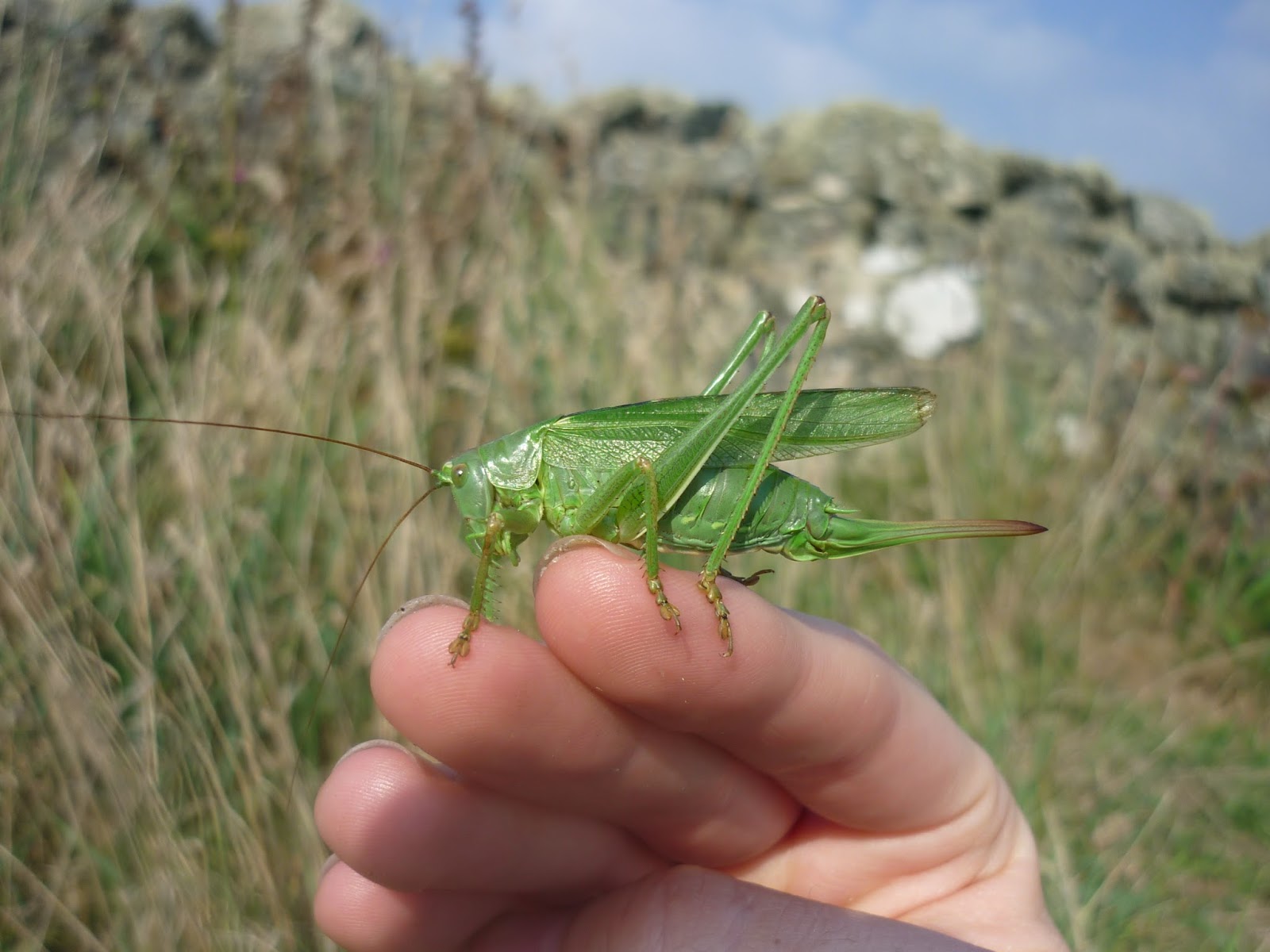
Other findings were a cute juvenile Common toad Bufo bufo and a young Great green bush cricket Tettigonia viridissima, the UK’s largest insect species. I later found an adult in the Lizard, Cornwall.

Oh and I painted a door. Quite impressive considering my colour palette started with just black, white, green and mustard.


Celebrating Slow Worms

About three weeks ago, back home, the Hertfordshire Amphibian and Reptile group (HARG) had a ‘Slow Worm SpeciaI’ meeting. If you didn’t know, the Slow worm Anguis fragilis, is one of the UK’s most misnamed animals, as it is actually a legless lizard, and is not especially slow (though it is usually more sedate than other lizards).
As part of the entertainments, I presented my dissertation on the importance of allotments as conservation habitat. Essentially, yes they are important.  As slow worms are also suffering from modern agriculture in our countryside, urban refuges provide a lifeline. Whilst allotments are not as good as some of the best nature reserves, they support viable populations, are themselves protected from developments, and can be improved.e.g. by cutting grassy areas later in the season when slow worms are less active, and by using organic ferrous slug pellets, which do not poison slug predators.
Afterwards, I was involved in translocating 16 out of over 160 individuals from a stretch of disused railway in Watford to the University of Hertfordshire’s field site at Bayfordbury , to make way for reinstatement of the route. Each slow worm had to be photographed for identification, weighed and measured. Soon we had a little inspection line going and I had the pleasure of holding one of this year’s babies and having a very large earthworm thrown up into my hand!  We then released our charges into a meadow and laid out refuges (carpet tiles for them to bask under) so they could be monitored by the University staff, students and the HARG team.


Whatever else?

In my hops across the country, I stayed in Cornwall (My parents have a retirement cottage there) and visited the Eden project which I do often. The place has a wonderful ethos, with beautiful outdoor gardens and fantastic  naturalistic indoor biomes. This time I met  the treefrogs and an exquisitely adorable family of roul roul, or crested partridges Rollulus rouloul in the tropical biome , which form part of the introduced ecosystem there as pest control.  The new butterflies and chrysalis hut provided extra fascination .


Out on the local beach, I saw a flock of Sanderlings  Calidris alba  for the first time( a small wader similar to the Dunlin), running a relay from the surf line to the strand line as fast as their little legs would carry them, only stopping to feed frantically at each goal post. Less lively was a shag  Phalacrocorax aristotelis I found buried in the sand. It turned out to be ringed by ornithologists from the Jersey Museum. We reported it, and found out when it was ringed from the nest, when it died-unfortunately prematurely at a mere 2 years, 1 month old, before it had reached adulthood-and other details. It is always worth investigating dead birds to see if they’re ringed and return the data to the hard-working researchers.

From Cornwall I went to Northamptonshire to friend’s, where I met Hector, the cheese-eating heron Ardea cinerea, and witnessed the speed of a red kite’s Milvus milvus strike , both of which she feeds from her garage roof. Not forgetting the peacock butterfly chrysalis which hatched overnight in a jar whilst we were there, named Chris (Surname Alice). We also  visited the immense lake of Rutland water and saw an Egyptian Goose  Alopechen aegyptica for the first time, a rather attractive, non-native shelduck  living in localised areas in the SouthEast.

Chris, the newly emerged peacock
                                       Hector the Cheese-eating Heron.


 Back home, I had a long overdue visit to Butterfly World in St Albans. Although it has a great tropical butterfly house it is so much more, with a large chalk wildflower grassland teeming with native species and several small, artistic wildlife gardens. It also houses the UK’s largest leafcutter ant colony, which were absolutely fascinating to watch (These are simply incredible and I can’t do justice to them here). In the tropical house we saw the World’s largest moths, the Atlas moth, and I had a hitchhiking owl butterfly on my jeans.


We also visited the RSPB headquarters at  Sandy. It’s a good day out, with woodland and heath nature reserves alongside the lodge itself and formal gardens. I particularly liked the pond, which had a central koi section with marsh garden islands and fenced off wildlife areas either end. Sadly, it was a bit devoid of birds this time of year, the highlights being large mixed tit flocks including Nuthatches Sitta europea and a Marsh tit Poecile palustris or Willow tit P.montanus (The two are near impossible to distinguish by sight).


I visited London with a friend to watch the harrowing film Blackfish, between visiting the scenic Kensington Gardens and the fascinating Cambridge physic garden, where every plant has it’s medicinal, cosmetic or cultural usage. I’m pretty sure we saw more alien than native birds there including better views of  more Egyptian geese, London’s famous Rose-ringed parakeets Psittacula krameri , a family of Mandarin ducks Aix galericulata and some hybrid Canada Branta Canadensis x Greylag Anser anser geese.


London: Proud to be multicultural.

One of the Canada xGreylag hybrids


Shortly afterwards, I was kindly aloud to stay in and explore the Beautiful county of Suffolk, where I wondered around various estuaries, including the Jewel in the birdwatching crown RSPB Minsmere. I saw a few species for the first time, including the very rare and special Yellow wagtail Motacilla flava, and amazingly saw two Ospreys Pandion haliaetous in as many days purely by chance! Even though they are exclusively fish eaters, it was the mass panic they caused amongst waders, gulls and other birds that gave them away.


As well as the birds at minsmere, I was delighted to find a sandy bank frequented by digger wasps, and got this photo of a bee-killer wasp Sphecius speciosus carrying a paralysed honeybee Apis melifera to her nest chamber, where she will lay an egg on it as food for her larva. Then she plugged the hole again and flew off to hunt another.


So is that a good enough excuse for you?  I hope you enjoyed that nattering about my holiday.  Letter J up next...


Saturday, 13 July 2013

I is for Icterine Warbler

Icterine warbler (Hippolais icterina).


The icterine warbler only just about classifies as a British Bird, but there is a severe shortage of natives beginning with ‘I’. It is a passage visitor (stops off on migration) and scarce migrant breeder in Britain.  It is usually found on the mainland in Western, Central and Northern Europe, all the way up to subarctic Russia. It is therefore surprising that Icterine warblers do not breed on our temperate isles more regularly. Perhaps crossing the waters of  the channel and the North Sea are just a little too much of a stretch on their exhausting  migration.  Although like many of our migrants the icterine warbler winters in sub-saharan Africa, it is excluded from the Mediterranean by its close and similar relative, the Melodious warbler (Hippolais polyglotta), which is also an occasional visitor to Britain.
Icterine warblers look as if they have been completely washed with yellow, including their greyish-green back.  The clue is in the name, as The name icterine means “yellowish’. This distinguishes them from our more common phylloscopid or leaf warblers, the Chiffchaff (Phylloscopus collybita), Willow  warbler (P. trochilus)and Wood warbler (P.sibilatrix), which are more greeny brown and only partly yellowed.
But icterine warblers don’t just have pretty looks, they also have a great voice. Their long, loud,  babbling, eclectic and almost electric song seems to carry on forever. To add to the song’s complexity, it sometimes also incorporates mimicry of other bird calls.

Otherwise, ‘Ickies’* have rather typical warbler habits. They are shy and spend their time skulking in vegetation, usually only  given away by their voice. They forage amongst the leaves for insects and summer berries.
Icterine warblers settle in habitats with dense hideaways such as woodlands, scrub and the edges of forestry plantations, preferably in river valleys.  They have only been confirmed breeding five times in Britain, all of which were in the Scottish Highlands. The first record was in 1992 and the latest in 2009, when two pairs bred. The young successfully fledged from at least two of these attempts, including four young raised in Orkney in 20021.

They use Britain more regularly as a hotel than as a nursery. An average of 137 drop in per year making them one of our most common rarities 2. Such visits often occur as crowds of birds rather than the occasional lost soul, and bigger crowds are thought to be related to breeding years . In the summer of 2009, 50 individuals were reported whereas a record 175 appeared in the first breeding year.
The detection of British breeding icterine warblers is thought to be a testament to the efforts of modern bird recording schemes. Britain is one of the great birdwatching nations, and the recent attempts to survey every square kilometre of the islands , in ‘tetrads’ mean even our wilderness areas miles from the nearest bird hide do not go unchecked. Thus the activity of such elusive birds gets noticed, and protective measures can be put in place.

It is interesting to think of this attractive visitor becoming more common in Britain. Perhaps it might follow the example of the Collared dove (Streptopelia decaocto), once a rarity from the mainland that had birdwatchers flocking, and now a staple garden bird. Only time will tell.


*I didn’t make it up. This is a common term used by birdwatchers.


References


1- Alan Tilmouth. (2009) BTO Atlas work produces Icky results. Available from: http://www.birdguides.com/webzine/article.asp?a=1764


2- Robert A Robinson. (2013)Profiles of birds occurring in Britain and Ireland-Icterine warbler Hippolais icterina   [Vieillot, 1817]. Available from:  http://blx1.bto.org/birdfacts/results/bob12590.htm

Wednesday, 10 July 2013

H is for House Sparrow

House Sparrow (Passer domesticus)

If I could pick a bird that means the most to me, it would be the house sparrow. Part of daily life at home was  to wake up to the discordant chirrups of the clan in the hedgerow, watch  them streaming to and from the feeder in the chicken  coup (never mind the bird table!) ,see them take dust baths on the garden path and hear them tumble shouting through the bushes in a dominance squabble .  Sparrows were the mainstay of our garden before the fancy finches arrived when sunflower hearts were provided, and thankfully it continues to support a strong population.
The house sparrow is a typical “little brown job” for birdwatchers, particularly the more uniform female. But look closer and you will see intricacy in their plumage with a surprisingly rich palette of browns and greys.  The male sports a grey cap trimmed with reddish brown, and a black beak and eye surround which give him a haughty expression. His most distinctive feature is a scruffy black bib. The size of this correlates with his fighting ability, so signals his dominance to other males and prospective mates. The female is a more modest dusty brown with a dark eye stripe and pale brow and her beak is yellowish. Juveniles are similar to females, but dumpier and with yellow “lips” around the bill that disappear with age.
Though they have a strong beak designed for seed-eating, sparrows are omnivorous (feeding off plant and animal matter) and take a variety of foods. They will nip the buds and flowers of plants, but also pick off insects such as ants, aphids and caterpillars. Sometimes they dart out of bushes, or comically hop along rooftops after flying insects. Importantly, young sparrows require protein-rich insect food in their early life.
The sparrow’s prolific breeding habits are part of their success. They may have 3 broods a year, and may show their uglier side in order to achieve this. Affairs, infanticide (by both males and females) and even eviction of other bird species, such as house martins, swallows and tits from their nests are all common practice.  Whilst such behaviour clashes with human values, it is simply a part of the sparrow’s ecology. They have also been helped in their world conquest by humans, who introduced them to America and New Zealand making them the World’s most widespread bird.
Few other British birds have such an intimate association with humans. It is difficult to imagine this species existing without us, occurring as it does around farms, industrial buildings and of course houses and residential areas whilst being largely absent from the wider countryside*. Their name ‘domesticus’ refers to their association with houses. They are such a part of British life that this line-up wouldn’t be complete without them.  It is therefore surprising the sparrow is not doing so well in modern times.
The sparrow’s history is thus intertwined with our own. As a flocking bird with a taste for grain, it was arable farmer’s enemy number one . A price was put on their heads and they were heavily persecuted. They were even eaten, especially their eggs which provided a free, to people who placed nest boxes on their home fronts to harvest them.
Then, in the 1800’s when farmhands moved to the cities in search of work, the sparrow was there too.  Feeding off spilt grain in horse fodder, the insects in their manure and human scraps and sharing the tenements as roosts and nests, they provided little reminders of home to many, whose attitudes changed towards these common birds.
The movement towards feeding wild birds in the Victorian era was eagerly received by the sparrow. They became a fixture of urban parks, where they grew tame and delighted visitors by feeding straight from their hands, a pastime within living memory.
House sparrows continued as a constant among the British public, but then, in the 1990’s a drastic  decline of this super-common bird raised surprise and alarm. In 2002, the RSPB declared it a red status species due to this rapid drop in numbers.
This was part of a decline in several phases since the 1920’s, caused by different factors in urban and rural areas. Rural sparrows became a victim of increased agricultural efficiency during and after the Second World War which affected all farmland wildlife. The reduction in arable weeds, intensified grazing and shift from ecologically diverse hay meadows to plain, grassy silage reduced the natural seed and insect foods in summer, whilst improvements in harvesting and storage meant less spilt grain as a winter food source. Hedgerows were removed, taking with them the sparrow’s roosts and shelter. Cities provided some refuge from these impacts, but the changes in transport and in urban planning, increased tidiness of gardens, and even blocking up of building eaves to discourage them all had their impacts.
But there is still hope for the house sparrow. They aren’t declining in all British cities, and numbers are actually increasing in Wales and Scotland. So perhaps the homage to J.J. Audobon’s illustration of the now extinct Carolina parakeet ( Conuropsis carolinensisisn’t so appropriate. 

You can help conserve house sparrows in your garden by providing plenty of bushes or a hedgerow (preferably a native species) as cover habitat, putting up sparrow nest boxes (preferably several individual boxes close together, as they dislike the disturbance caused by commonly marketed multi-chamber boxes)  and of course feeding and watering the birds. They are not fussy. Mixed seed, sunflower hearts, peanuts and suet will all be appreciated.  
With the help of ordinary townspeople, the sparrow may still cling on. I hope it does.  Britain would be a much poorer place without this common and characterful bird.
House sparrows are not the only sparrow in the British Isles. Their rarer, more strictly rural cousin, the Tree sparrow (Passer montanus), has an entirely chestnut cap, a black cheek patch and near-white (as opposed to grey) underparts. Confusingly, the dunnock (Prunella modularis) is commonly called the ‘hedge sparrow’, and though the plumage is remarkably similar to the female house sparrow, they are unrelated. Their name is a relic from a time when ‘sparrow’ applied to any small, brown bird. In relation to this, in the sparrow’s scientific name passer we see the origin of ‘passerines’, the entire group of perching birds.
To find out more about the great house sparrow decline, visit http://www.ndoc.org.uk/articles/Decline%20of%20the%20House%20Sparrow.pdf


*Specifically, more than 60% of the population live in built up areas, with more than half of these occurring in suburban areas, according to the BTO’s Breeding Bird Survey.

Friday, 28 June 2013

G is for Goldfinch

Goldfinch (Carduelis carduelis)


Who can resist the allure of the goldfinch? Its glorious plumage, with the namesake bright yellow wing-bars and crisp white spots on black wings;the smart face mask of scarlet, black and white, and its delicate ivory bill offsetting a body the colour of golden sands.  Its voice is befitting of its appearance, with a tinkling contact call and a song described as “a liquid trickling ramble1.  Best of all they are rarely found alone, and a flock of goldfinch is called a ‘charm’ , defined as ‘the blended sound of many voices’ from their constant calls to each other rather than the character trait2. The cheerful intermingled chorus of several goldfinches is one of my favourite bird songs.

The goldfinch is yet another bird that has expanded its range in Britain in recent history.  Its UK population status went from Amber in 1996-2001 to Green from 2002 onwards*.  Traditionally a bird of the open countryside in open grassland, fallow fields and weedy margins, it has now won the hearts of many a suburban dweller. This is largely due to people feeding the birds in their gardens and the increase in variety of bird foods offered. Nyger seed is often recommended as a specialist food for these finches, since it is small and narrow, emulating their natural diet, but those in my garden far prefer the plumper sunflower hearts. Despite their small size, they will hold their own against the larger sparrows and chaffinches on the feeders.

The goldfinch is famous for its natural diet of teasle and thistle seeds, indeed the scientific name Cardeulis comes from Carduus for thistles.  They also forage on other small seeds such as knapweed, dandelions, and alder and birch trees as well as a few insects.  Bouncing flocks will descend on fields of these plants, with individuals daintily poised on and acrobatically reaching around a chosen seed head.
Their narrow bills are well suited to prising food from these, but there is more going on than meets the eye. Instead of simply plucking the seed, these finches have stronger jaw muscles to open their bill than other species, which they use tp prise the seed sheath apart. They then pick out the seed with their tongue. Fascinatingly, studies have shown niche separation between the sexes. Males have slightly longer bills to feed on teasles, whilst females prefer thistles1. Therefore you can judge the sex of a goldfinch flock by what they are feeding on (which is otherwise difficult as both sexes are equally showy).

Goldfinches have peculiar nesting habits for a finch. Rather than tucked away in a hedgerow, they prefer to build on the ends of a thin branch, out of reach of larger predators. The nest is stereotypically cup shaped with high sides to prevent the eggs or chicks from falling out in branch-shaking winds. Less charming is the offspring’s habit of caking the outside of the nest with droppings to deter predators!  This is another opposite to the normal passerine strategy, as most species carry off droppings to avoid predators detecting the nest.
As with most birds, young goldfinches are not as striking as their parents, being a streaky grey with no head markings. They are still recognisable by their wing bars.

Perhaps unsurprisingly,  goldfinches were highly- prized cage birds and especially so in Britain during the 1800’s when the capture of native birds was at its peak. Millions were collected to supply this industry, to the point that wild populations were seriously affected.  In Worthing, Sussex alone, an estimated 132,000 goldfinches were captured in 18603. The forerunner to the RSPB, The Society for the Protection of Birds made the protection of goldfinches one of their main missions.
Though capturing these birds was already illegal under the Protection of Birds Act (1880), the law was cemented by the Wildlife and Countryside Act (1981) and capture has largely stopped (Though unfortunately they are still illegally caught by some).
The legal practice of keeping captive-bred, ringed and registered goldfinches continues. This includes the breeding of ‘goldfinch mules’, hybrids between goldfinches and canaries which combine the goldfinches’ colouring and sound with the canary’s’ singing prowess. A goldfinch mule in full song can be seen here.

Whilst I’m sure these caged goldfinches bring great joy to many, I’d rather watch this gem of a bird living free on my garden feeders and flying in charms across Britain.


The European goldfinch is not the only species. There are three more types in America. The American goldfinch,  a handsome bird of bright yellow with a black cap and wingtips,  the Lesser goldfinch, which is greener and rather like a male siskin and Lawrence’s goldfinch which is grey with a yellow breast. In my opinion, none of these are as stunning as our own!


*What does this mean? Go here


References

1-Dominic Couzens. (2012) Garden Birds Confidential. Bounty Books.

2- Fransesca Greenoak. (1979) All the Birds of the Air. A. Brown and Sons.

3-Ian Newton. (1975) Finches. Collins. Cited by: Mark Cocker. (2005) Birds Britannica. Random House.